Location: Poloniny National Park East Slovakia
Step into one of Europe’s last untouched natural wonders. Tucked away in the remote Bukovské Vrchy mountains near the Slovak–Ukrainian border lies Stužica, a breathtaking primeval beech forest and part of the UNESCO WORLD NATURE HERITAGE-listed Ancient and Primeval Beech Forests of the Carpathians.
Located at the junction of Slovakia, Poland, and Ukraine, Stužica forms the heart of Poloniny National Park. The park also encompasses other significant forested areas, including Havešová, Rožok, Udava, Vihorlat, and the broader Bukovské Vrchy range. The unique Havešová Primeval Forest in the Nastaz Mountains can be visited by tourists, accompanied by the guides from the Poloniny National Park Administration in the village of Stakčín, who provide expert commentary for visitors
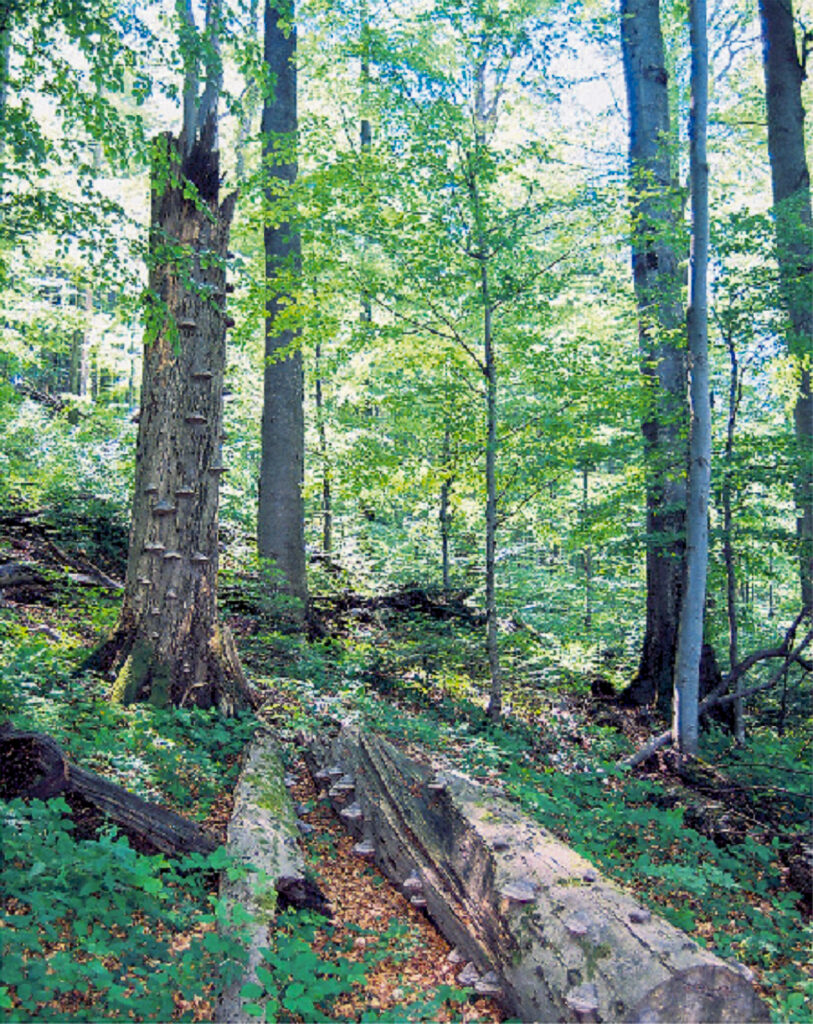
The Stužica National Nature Reserve spans 761.43 hectares, making it the largest primeval forest in Slovakia. Renowned for its rich biodiversity and tranquil beauty, the forest is the home to towering trees such as European beech (Fagus sylvatica), European silver fir (Abies alba), and Sycamore maple (Acer pseudoplatanus). The wildlife includes brown bears, wolves, lynxes, and even moose — all living in a largely undisturbed ecosystem that reflects what Europe’s ancient forests once looked like.
One of the forest’s rarest inhabitants is the European bison, which survives in the wild in Slovakia only in Poloniny. Some trees in Stužica are two to three centuries old. The widest fir tree has a trunk circumference of 392 cm, while the widest beech measures 322 cm.
Hiking enthusiasts can explore this wilderness via the red hiking trail, the oldest in the Poloniny Mountains. It begins in the village of Nová Sedlica and winds through the Stužica forest. Two additional trails also start here: the green trail, which ascends to Čierťaž (1,071 m) at the Slovak–Polish border, and the yellow trail, which leads to Riaba skala (1,167 m). Both routes offer panoramic views, according to environmentalists. Another trail, marked from Osadné (Snina District), passes through the Udava primeval forest to Balnica, where visitors can ride a historic narrow-gauge railway train.
Just 25 kilometers northwest of Stužica lies another UNESCO World Culture Heritage — the Greek Catholic wooden Church of St. Nicholas in Bodružal, built in 1658. Nearby, travelers can also visit the Church of St. Michael the Archangel in Ladomírová, and to the south, the Greek Catholic wooden Church of St. Nicholas the Bishop in Ruská Bystrá, dating from 1730. All of these churches are part of the UNESCO World Cultural Heritage.
Author: Daniela Capcarová ©