The oldest in Europe
Location: Start and Finish
It was in the summer of 1924 that Vojtech Braun Bukovský, Košice sports enthusiast, organizer, and journalist in one person, went to see the Olympic Games in Paris. The enthusiasm he returned home with was channelled into his decision to organize a marathon race, as it was this particular discipline which thrilled him the most in Paris. And so it happened that just a few weeks later, on 28th October, the day of the 6th anniversary of the establishment of Czechoslovakia, eight brave pioneers lined up for the start below the ruins of Turňa Castle and then set off in the direction of Košice, towards a then still unsuspected adventure. The first winner, local runner Karol Halla, tried defending his first place another nine times altogether, but the growing competition was against this. The very second edition already had an international line-up, and the winners’ laurels from the third were carried of to Germany around the neck of Paul Hempel. He was sent here by the Charlottenburg Sports Club, which still exists to this day and stands, as it has always stood, behind the Berlin Marathon.
Current track record holders are:
Cherop Philemon Rono (KEN) with 2:06:54 from 2023 and Margaret Agai (KEN) with 2:24:04 from 2022
The Marathon quickly made itself at home in Eastern Slovakia and started getting a response from the rest of the world as well. One persistently memorable year was 1931, when the 20-year-old Argentinian new boy Juan Carlos Zabala shocked everyone with his course record of 2:33:19. Many doubting voices were raised, but they were all silenced a year later by Zabala’s victory at the Olympic Games in Los Angeles. It must be stressed that the performances achieved in Košice always had the hallmark of credibility, because since 1924 the course has been remeasured every year exactly in accordance with the rules to ensure it conforms with the now generally acknowledged 42,195 kilometres. This has not always been as self-evident as it might seem, when even as late as 1956 for example the Boston Marathon was run over a course of only 40.6 km.
Not even the torments of war could stop the Marathon, and its continuity was preserved. The early snowfall in 1946 was a kind of premonition that the era of the Northerners was beginning. In the ten years following that snowfall, runners from Norway, Sweden and Finland won a total of eight times, with the Swede Thomas Nilsson finally setting a new course record of 2:22:06 in 1956. During that period the Košice Marathon had a superb reputation in Scandinavia. “May Boston forgive us, but the greatest marathon contests in the world are being played out in Košice,” wrote the daily Göteborg Posten. And the leader of the Swedish team announced: “If I could, I would declare the Košice Marathon the official championships of Europe – it is unofficially so today in any case.”
The year 1989 brought great changes in more than one sense. Less than two months before the Velvet Revolution, it looked like the Marathon itself was anticipating the changes in society. The traditional course going out to Seňa and back, which had awaited the runners from 1926 onwards, was replaced with a city circuit. This attracted the attention of the whole world in 1997, when the IAAF World Half-marathon Championships were held in Košice.
The Košice Marathon is certified and awarded with 5 Star Quality Road Race by European Athletics.
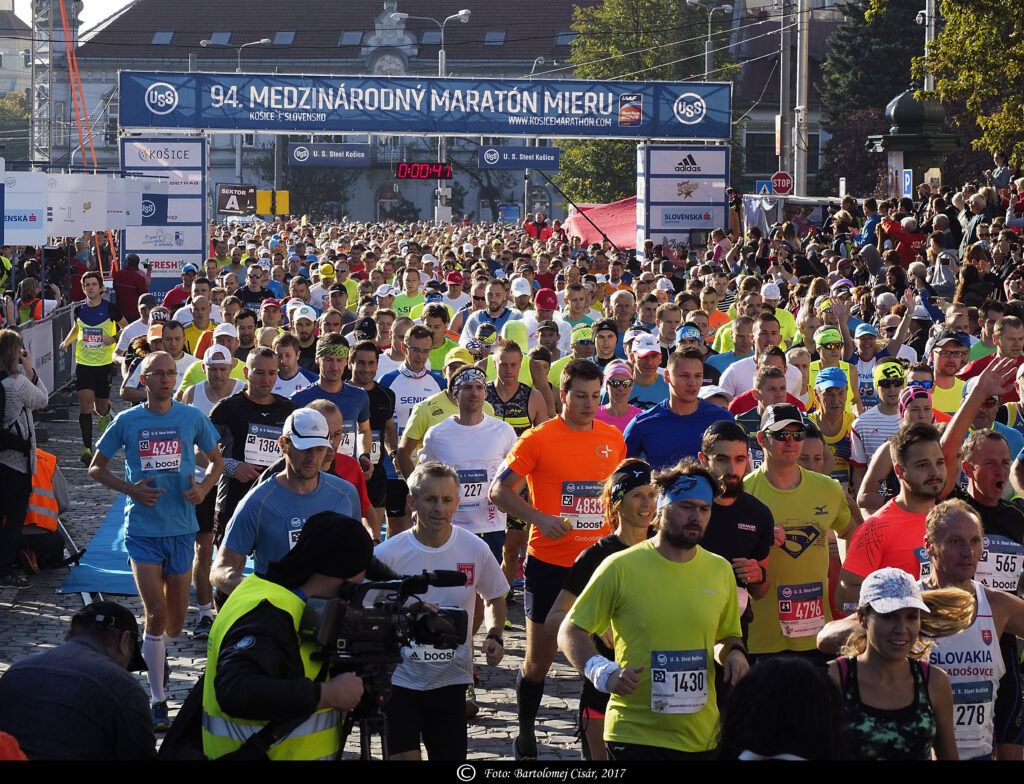
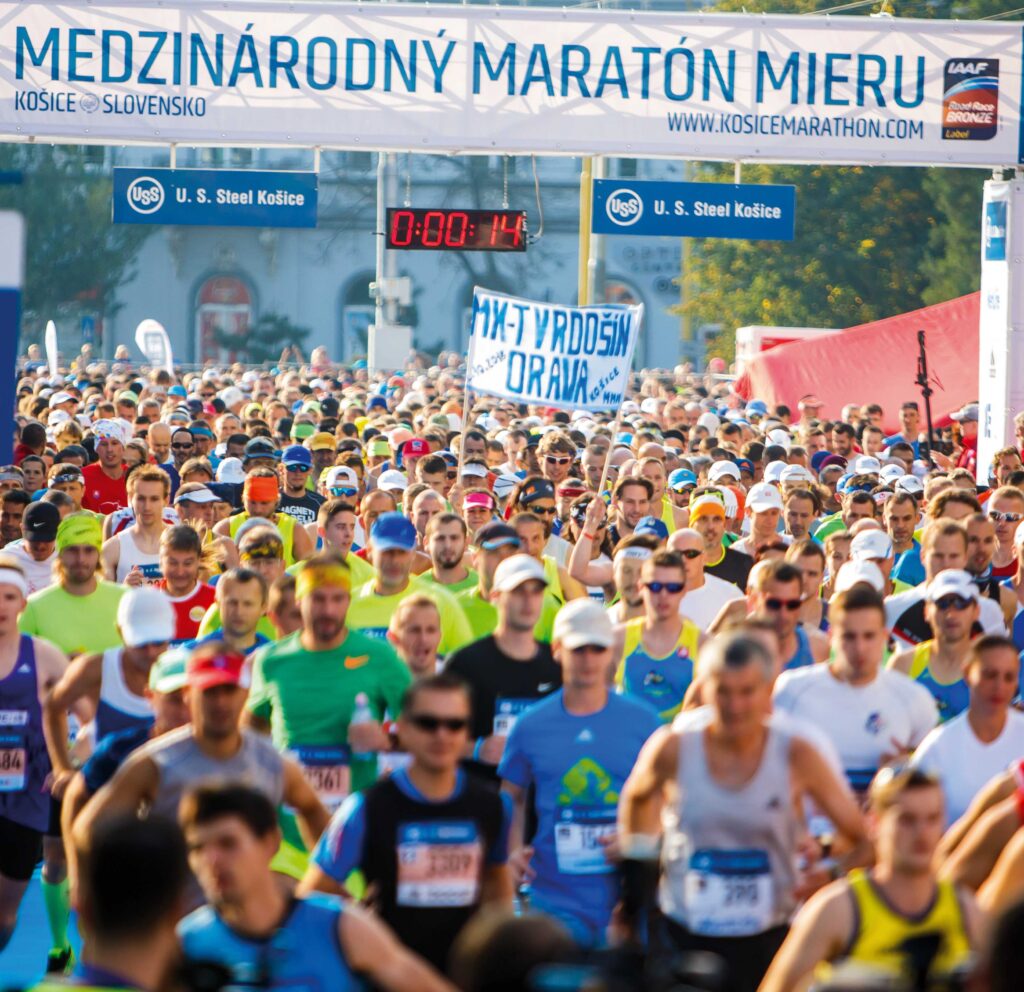
Today the Košice Marathon is a colourful festival of sport and fun, attracting roughly 17 000 participants from all over the world. All those running around the extensive historical centre of this city, the first in Europe to acquire its own coat of arms from King Louis the Great in 1369, must surely admire the Gothic St. Elizabeth’s Cathedral from the 14th century and a great many other architectural gems in this metropolis. It was also thanks to this heritage and its programme of creative transformation that Košice gained the title of European Capital of Culture for the year 2013.
This Marathon is attractive not only due to its tradition and precise organization, and the olden-day charm of the city, but also for the fast course it offers. The Košice Marathon has unusual atmosphere, streets full of runners and spectators, and positive energy which everyone recharges themselves with mutually. This is an image which reflects 100 years of existence of the marathon phenomenon in this city.
Košice Peace Marathon
www.kosicemarathon.com